
Facts checked on 28 Nov 2026 against DLD, RERA and Central Bank pages (listed at the end). Fees, forms and processing times change. Confirm the current requirement with the Dubai Land Department, your developer or your bank before you pay or sign.

What selling a property in Dubai involves
If you want to know how to sell property in Dubai, start with the legal sequence, not the online listing. Selling a house in Dubai, or learning how to sell an apartment in Dubai, follows the same official path for a ready home: sign Form A (Contract A) with a licensed broker, price from recent registered DLD sales, line up the title deed and a developer e-NOC, obtain a Trakheesi advertising permit, agree terms in Form F (the unified sale contract, often called the memorandum of understanding), clear any mortgage, and transfer at a Real Estate Registration Trustee office.
Off-plan resales before handover follow a close path, but the transfer sits on the provisional register (Oqood) and the developer’s no-objection rules apply. See off-plan property in Dubai, selling off-plan before handover, and the buying process guide.
Step 1: appoint an agent and sign Form A
Form A, usually called Contract A, is the marketing agreement between the owner and a licensed brokerage. RERA’s Real Estate Brokerage Practice Guide describes it as an agreement to market a property between the seller and the brokerage. It records the title-deed details, the agent, the agreed commission, the duration, and whether the listing is exclusive or non-exclusive.
Commission is not a fixed DLD rate. DLD’s FAQ says the broker processes the sale “with a specific commission agreed upon by the two parties.” Put that figure in Form A, and later in Form F. The contract is created in the Dubai REST app or the Dubai Broker web application, then submitted for the owner to approve.
Form A comes first because of the advertising permit. DLD’s 2025 Trakheesi User Manual says that, for a property ready for sale in Dubai, the broker must enter the number of marketing contract A, then settle the fees, to obtain the permit. No approved Form A, no permit, and no legal public advert for that ready listing. Appoint a broker who holds a current DLD broker card and works under a RERA-registered brokerage. See how to become a real estate agent in Dubai and our guide to RERA Form A.
Step 2: price the home from recent DLD sales, not asking prices
The fastest way to stall a listing is to price it from what similar homes are asking, not from what they sold for. The figure that matters is the sale value registered with the Dubai Land Department.
Use DLD’s real estate transactions data, the Residential Sales Price Index, and the sale index in the Dubai REST app. Compare recent sales of similar size, view and condition in the same community, then adjust. Agree a review date so the price can move if viewings come and offers do not. See Dubai real estate hacks to sell property faster.
Step 3: paperwork, title deed and developer NOC
Get the file complete before you spend heavily on marketing. Assemble the current title deed, the seller’s Emirates ID or a valid passport (if they are a non-resident foreigner), a clear service-charge position, a notarised power of attorney if someone will attend in the owner’s place, and, if the property is mortgaged, a liability letter from the bank.
In freehold areas, DLD requires a no-objection e-certificate (e-NOC) from the developer, issued through the Dubai REST app. DLD’s eNOC guide says a request for a ready property on the Mollak service-charge system takes 3 to 5 working days, and that approval is sent electronically with a validity period. That path is for Mollak-managed properties; the management company may still contact the developer if needed. NOC fees vary by developer, and some certificates are valid for only a short period, so book the trustee appointment as soon as the NOC is issued. Outstanding service charges usually have to be cleared first. For Emaar-specific notes, see how to sell Emaar properties in Dubai.
Step 4: marketing that gets viewings (photos and permits)
A broker needs a real estate advertising permit from DLD, issued through Trakheesi, before publicly marketing a property. That covers electronic, classified, print, outdoor and open-house ads, and the other types listed on DLD’s Real Estate Ad Permit page. For a ready sale, the approved Contract A number is an input to that application.
Compliant adverts carry a QR code issued through Trakheesi. DLD’s Madmoun service, in effect since 24 April 2023, lets anyone scan that code to check that the advert was approved, and DLD advises the public to deal only with advertisements that feature it. RERA Circular No. 2 of 2022 adds that every ad must show the permit number and the company name, may carry only information approved in the permit, and needs a promotional campaign permit if it offers discounts or fee waivers. Off-plan ads must also show the developer, project name, project number, location and escrow account number. The DLD fine reported in its public notices is AED 50,000 per violation.
A permit does not replace good marketing. The first photo should show the home clearly, the description should match the title deed, and inquiries should get a fast reply. See our Trakheesi permit guide.

Step 5: offers, negotiation and the memorandum of understanding
When a buyer and seller agree a price, the deal is written into Form F. RERA’s brokerage practice guide calls Contract F “an agreement to sell a property between the seller and the buyer.” DLD’s investor guide, Know Your Rights, describes it as the standard form of sale contract, and says parties may add terms that do not conflict with the standard ones. Agents and owners often call it the memorandum of understanding (MOU). It is the same document.
DLD’s broker journey shows Form F being created from an approved Contract A in Dubai REST, with the financial details, duration and who pays the DLD fee entered before approval. Form F should state the price and deposit, the transfer date, who pays the 4% DLD fee and the trustee fee, the commission already agreed in Form A, and what happens if an NOC or a payment is delayed. Know Your Rights also states that the transaction must be registered within 60 days of signing the sale contract, subject to a fine if it is late. See how to close more real estate deals.
Step 6: trustee transfer, fees and handover
All real estate sales in Dubai are completed through Real Estate Registration Trustee offices, which represent DLD. Seller and buyer, or their legally authorised representatives, attend with the required documents. The trustee officer checks the file, enters the transaction, takes payment, and DLD sends the output by email. See DLD’s directory of trustee offices.
What you pay at transfer
Official DLD fees for registering the sale of a completed property, as listed on the Property Sale Registration service page:
| Fee | Amount (as of Nov 2026) |
|---|---|
| Sale registration (DLD) | 4% of the sale value, listed as 2% seller and 2% buyer; the legal default is equal sharing unless the parties agree otherwise |
| Title deed issuance | AED 250 |
| Map / plan fee | AED 250 for villas and apartments (AED 225 for a unified map under Dubai Municipality; AED 100 for land outside it) |
| Knowledge and innovation fees | AED 10 + AED 10 |
| Registration trustee (service partner) fee | AED 4,000 + VAT if the sale value is AED 500,000 or more; AED 2,000 + VAT if it is less |
| Mortgage registration (if the buyer borrows) | 0.25% of the mortgage value, plus AED 250 title deed and AED 10 + AED 10 fees |
Executive Council Resolution No. 30 of 2013 sets the fee at 4% of the contract value and says that, unless agreed otherwise, it is shared equally. DLD’s service page lists it as 2% from each. In practice, many Form F contracts provide that the buyer pays the full 4%. That is a matter of agreement, so write it into the sale contract. See our DLD fees guide. Commission, NOC fees, bank charges and mortgage-release fees sit on top of this table.
If the property is mortgaged
You can still sell a mortgaged home. DLD asks for a liability letter from the bank, IDs for both parties, and three manager’s cheques: one for the bank or developer (the debt), one for the seller (any remaining equity), and one for DLD (the 4% fees). The bank’s cheque is then used to obtain a mortgage release letter. DLD says registration is completed only after that letter is submitted. Extra release fees apply; check the live amounts on DLD’s mortgaged-property sale page, and start the liability letter as soon as Form F is signed. Once registered, DLD issues the new title deed and the keys are handed over on the terms agreed in Form F.
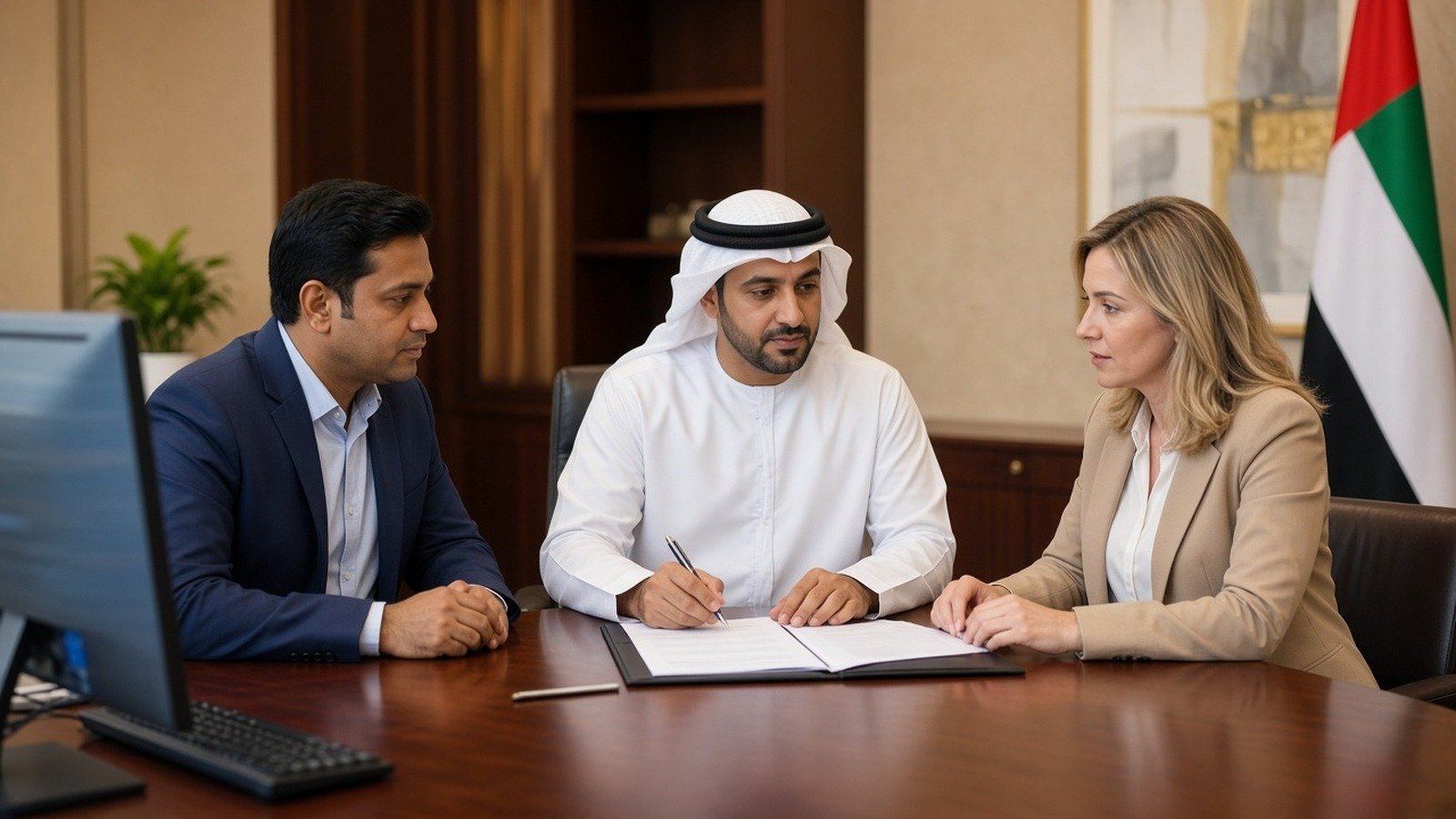
Who pays what when you sell, and what you receive
Most of the DLD costs fall at transfer, and the sale contract (Form F) decides who bears them. The table above lists the DLD fees; these are the items an owner usually deals with:
- DLD registration fee: 4% of the sale value. DLD lists 2% from the seller and 2% from the buyer, and many contracts make the buyer pay all of it. Write the clause into Form F.
- Agent commission: not fixed by law. DLD’s FAQ says it is whatever the two parties agree, so it belongs in Form A. A common market arrangement is a percentage of the price plus 5% VAT.
- Developer NOC fee: set by each developer, not by DLD, and usually paid by the seller. Ask the developer for the current amount.
- Mortgage release: on DLD’s mortgaged-sale page the release procedure fee is AED 1,290 and the registrar’s release fee is AED 315, which is AED 1,605 in total, plus any early settlement fee charged by the bank.
- Early settlement fee: the Central Bank caps it on a home loan at 1% of the outstanding balance or AED 10,000, whichever is less, excluding VAT. Check your loan agreement.
Worked example: AED 2,000,000 apartment with a mortgage
Say the home sells for AED 2,000,000, AED 850,000 is still owed on the mortgage, the buyer pays the DLD fee and trustee fee, and the seller pays a 2% commission plus VAT. These are illustrations, not quotes.
| Item | AED |
|---|---|
| Sale price | 2,000,000 |
| Mortgage payoff (from the bank’s liability letter) | -850,000 |
| Early settlement fee at the 1% cap | -8,500 |
| Commission at 2% plus 5% VAT | -42,000 |
| DLD mortgage release fees (1,290 + 315) | -1,605 |
| Cash to the seller before the developer NOC fee and service charge arrears | 1,097,895 |
If Form F splits the 4% DLD fee equally, the seller’s 2% share is another AED 40,000. Outstanding service charges and the developer’s NOC fee are deducted on top, so ask for both figures before you agree a transfer date.
How long a sale usually takes in 2026
There is no official DLD figure for how long it takes to find a buyer. That depends on price, condition and demand. Official timings apply once the file is complete:
- e-NOC: 3 to 5 working days, according to DLD’s eNOC guide, for a ready property on the Mollak path.
- Trustee appointment, unencumbered sale: DLD’s Property Sale Registration page lists an expected 20 minutes. The DLD FAQ also describes an average of 30 minutes when all documents are available.
- Trustee appointment, mortgaged sale: DLD lists 15 to 20 minutes at the counter, after which the mortgage release letter still has to come back from the bank.
- Registration window: the transaction must be registered within 60 days of signing the sale contract, subject to a fine if it is late.
Build the NOC, the liability letter and the trustee booking into the Form F timetable, rather than starting them after a handover date is already set.
Off-plan resales before handover
An off-plan resale is different from selling a ready home, because the unit is still on the provisional register and the buyer steps into the seller’s contract with the developer. DLD’s FAQ is clear: “Resale is possible after obtaining a No Objection Certificate from the developer.”
Whether you can sell yet is a developer condition in the sale and purchase agreement, not a single DLD percentage. Some developers only issue a resale NOC after a stated share of the price has been paid, and that share varies by project, so read the SPA and request a statement of account. Due instalments generally have to be cleared first, and a bank must also approve if the unit is mortgaged. Form A and a Trakheesi permit are still required before any public advert. The transfer is registered on Oqood, and DLD’s initial-sale service lists the same 4% sale registration fee (2% seller, 2% purchaser). For the detail, use the off-plan explainer and selling an off-plan property before handover.
Common mistakes that stall a listing
- Advertising before Form A and the permit are in place. A WhatsApp mandate is not a marketing contract, and buyers can check the QR code.
- Pricing from asking prices instead of registered DLD sales.
- Leaving the NOC and mortgage letter until the week of transfer. Start them when Form F is signed, or earlier if the developer allows.
- Leaving the 4% fee clause vague. If the buyer is to pay the full 4%, write it in Form F. The official default is equal sharing unless you agree otherwise.
- Missing the 60-day registration window after the sale contract is signed.
- Treating an off-plan resale like a ready sale. The SPA, the paid-up amount and the developer NOC decide whether it can proceed.
- Poor listing quality once the permit is in hand: weak photos, a mismatched description, or slow replies.
How to sell property in Dubai: frequently asked questions
How do I sell a property in Dubai?
Appoint a licensed broker, sign Form A, price the home from recent DLD sales, get a Trakheesi permit, agree terms in Form F, obtain the developer e-NOC, clear any mortgage, and complete the transfer at a Real Estate Registration Trustee office.
Who pays the 4% DLD transfer fee when you sell property in Dubai?
DLD lists the fee as 2% from the seller and 2% from the buyer. Executive Council Resolution No. 30 of 2013 says it is shared equally unless the parties agree otherwise. Many sale agreements provide that the buyer pays the full 4%. The clause in Form F is what the trustee will follow.
Do I need Form A and a Trakheesi permit to advertise a property in Dubai?
Yes, if a broker is marketing a ready property for sale. DLD's Trakheesi manual says the broker must enter the approved Contract A number and settle the fees to obtain the permit. The permit number and the Madmoun QR code must appear on the advert, and the permit is only valid for the information approved in it.
How long does it take to sell a property in Dubai?
The time to find a buyer depends on price, condition and demand; there is no official average for that stage. Once paperwork is ready, DLD lists 3 to 5 working days for an e-NOC on Mollak-managed ready properties, and an expected 20 minutes at the trustee office (the DLD FAQ also describes an average of 30 minutes). The sale should be registered within 60 days of signing the contract.
Can I sell an off-plan property in Dubai before handover?
Yes. DLD's FAQ says resale is possible after obtaining a no-objection certificate from the developer. Whether you can sell yet, and any minimum amount that must already have been paid, is a condition in your sale and purchase agreement, not a single DLD percentage rule. The transfer is then registered on the provisional register (Oqood).
What documents are needed at the trustee office to complete a sale?
DLD asks for the Emirates ID of the seller and the buyer (or a valid passport for non-resident foreigners) and, in freehold areas, a developer e-NOC issued through the Dubai REST app. If the property is mortgaged, DLD also asks for a bank liability letter, manager's cheques for the debt, any balance due to the seller and the 4% DLD fees, and then a mortgage release letter to finish the registration.
Can I sell property in Dubai while I still have a mortgage?
Yes. DLD asks for a liability letter from the bank and three manager’s cheques: one for the bank, one for the seller’s remaining balance and one for DLD’s fees. Registration is completed after the bank’s mortgage release letter is submitted.
Is there a limit on early settlement fees when I sell a mortgaged home?
Yes. The Central Bank caps the early or partial settlement fee on a home loan at 1% of the outstanding balance or AED 10,000, whichever is less, excluding VAT. Check your loan agreement for any fee-free allowance.
What do I actually receive when I sell an apartment in Dubai?
The sale price less the mortgage payoff, any early settlement fee, commission with VAT, the DLD mortgage release fees, the developer NOC fee, your share of the 4% DLD fee if Form F gives you one, and unpaid service charges. In the worked example above, an AED 2,000,000 sale with AED 850,000 owed leaves about AED 1,097,895 before the NOC fee and service charges.
Sources
- DLD: Property Sale Registration (fees, documents, 20-minute expected time)
- Dubai Executive Council Resolution No. 30 of 2013 (DLD fee schedule)
- DLD: Know Your Rights for investors (Form F, 60-day registration, trustee transfer, developer NOC)
- RERA / DLD: Real Estate Brokerage Practice Guide 2024 (Contracts A, B and F; Trakheesi; trustee offices)
- DLD: Trakheesi User Manual 2025 (Contract A number required for a ready-sale permit)
- DLD: Real Estate Ad Permit
- DLD: Madmoun QR-code service for verifying real estate ads
- DLD: Broker’s Journey to create Contract F
- DLD: Electronic No Objection Certification (eNOC) guide (3 to 5 working days)
- DLD: Registering the Sale of a Mortgaged Property
- DLD: Real Estate Registration Trustee centres
- DLD FAQ (off-plan resale after developer NOC; average 30 minutes to register a sale; commission is agreed between the parties)
- DLD: Request to register the initial sale (Oqood)
- DLD: Dubai REST app (sale index, contracts, e-NOC)
- DLD: Residential Sales Price Index
- DLD: Real Estate Transactions
- RERA: Circular No. 2 of 2022, real estate ads terms and conditions
- Central Bank of the UAE Rulebook: Appendix 2, Regulation No. 29/2011 (early settlement fee cap)